
GLOSSARY OF PIANO SERVICES
This glossary gives details about the various services that piano technicians offer.
If you can’t find the answer to your questions here, check our FAQ page.
WHAT IS PIANO TUNING ALL ABOUT?

Tuning Hammer
The tool used to turn the tuning pins is called a tuning hammer, tuning wrench, or tuning lever.
The oldest hammers have a shaft made of wood. In decades past, various plastics were used. Now, the best tuning hammers are made of carbon fiber and are very lightweight.
Carbon fiber is also very stiff, which is helpful to the piano tuner in being able to “feel” the pins more accurately as they are being adjusted.

Tuning Pins
The strings are wrapped around steel tuning pins which are turned to bring the pitch up or down. In a piano that’s tuned regularly, the movements made are extremely small, sometimes just lightly bumping the pin or even pushing gently against it is what it takes to get the strings in perfect tune.
Learning how to do this well, and how to leave the string exactly where you want it to stay, takes years of practice.

Why does a piano go out of tune?
The strings of a piano cross a bridge, which transfers the sound to the soundboard, a large thin piece of softwood. In the summer, the soundboard swells as it takes on humidity, and shrinks as it loses humidity in the winter.
Each time the soundboard goes through this yearly cycle of pushing against the strings, and then relaxing, the strings lose tension, and end up further and further away from being in correct tune.
If your home’s environment fluctuates greatly, your piano will benefit from a humidity control system.

E.T.D.
Most tuners these days use an Electronic Tuning Device (E.T.D.) to set pitches by. There are several options to choose from, including stand-alone devices and software which can run on a phone.
Whether tuning by ear or by using an E.T.D. is superior, is a subject that piano tuners like to argue about.
I was trained to tune by ear, but have adopted an E.T.D. into my toolbox. I rely on both, which is known as a hybrid tuning style.

Temperament Strips
Another method of isolating just the middle strings is by pressing a long strip of felt called a “temperament strip” in between each set of 3 strings. This is most commonly used by piano tuners who tune aurally (tuning by ear).

Mutes
Are you having your piano tuned more often than necessary or not often enough?
Try this calculator to see our customized recommendation for your specific situation.
WHAT IS A PITCH ADJUSTMENT?

Restoring Stability
When a piano is not tuned regularly, this desired balance is thrown off, and the results of a tuning without this preparation are unsatisfactory.
Our “New Customer Service” includes a pitch adjustment.

Increasing Tension
This is necessary when a piano hasn’t been tuned for several years, in order to bring the tension on the strings and plate into equilibrium and to restore stability.

Rough Tuning before Fine Tuning
WHAT IS PIANO HAMMER
RESHAPING AND VOICING?

Hammer Voicing

Hammer Reshaping
Years of playing causes hammers to gradually lose their ideal pear shape and flatten out where they strike the strings. This also causes the hammers to form grooves on them from the strings, which can dramatically affect the tone quality of the instrument.
Reshaping is the act of carefully filing the hammers down to their correct original shape. Reshaping is always followed by voicing.

Piano Hammers
Piano hammers are the teardrop shaped “mallets” which strike the strings, making the piano sing. Hammers are made of very dense felt wrapped around a small wooden core.
WHAT IS PIANO REGULATION?
Pedals et.al.
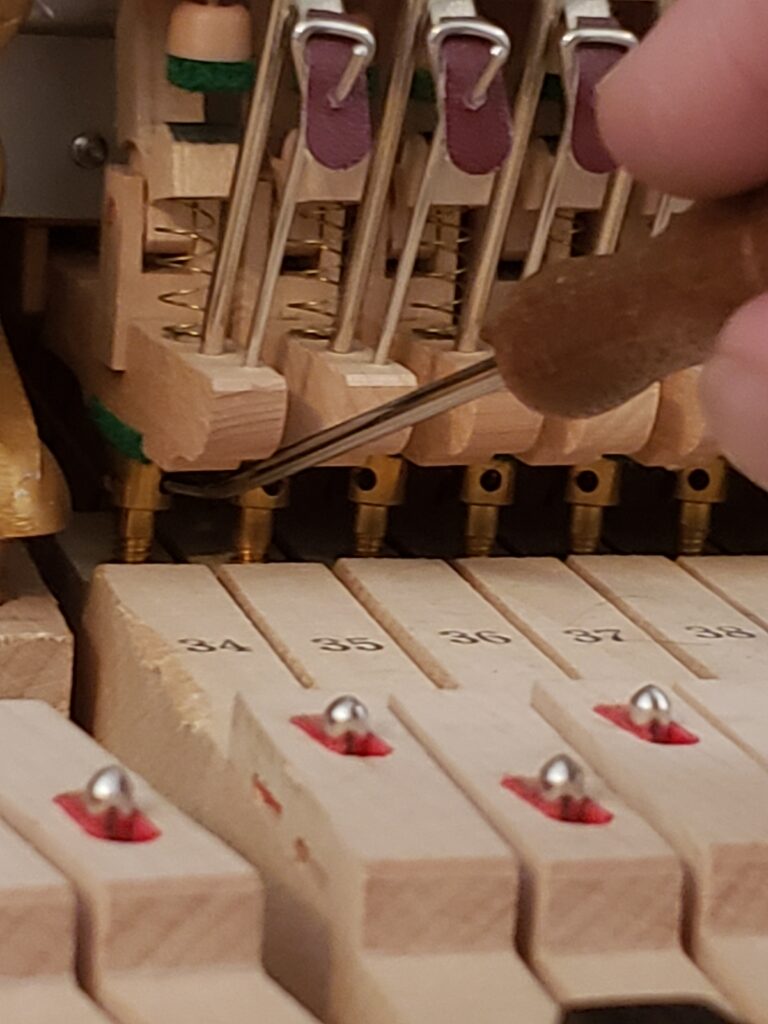
Regulation also includes making sure the hammers are hitting the strings exactly right, adjustment of the pedals, and a thorough check of all parts of the piano.

Adjustments to the Action
Regulation is the process of correcting for these inconsistencies by adjusting the numerous screws and springs in the action (and other adjustments), thereby setting these tolerances and measurements back to factory specifications.

Explanation
WHAT DOES HUMIDITY HAVE TO DO WITH PIANOS?

Controlling Humidity
The less fluctuation in temperature and humidity we can obtain, the better in tune a piano will sound year ’round. We aim for about 45% relative humidity.
Burd and Sons has extensive experience installing humidity control systems.

The Soundboard
Each time the soundboard goes through this yearly cycle of pushing against the strings, and then relaxing, the strings lose tension, and end up further and further away from being in correct tune.
Environmental Fluctuations

Other Benefits
In addition to keeping your piano in better tune throughout the year, there are other benefits as well.
Excess humidity can cause strings and tuning pins to rust and the moving parts of your piano (the action) to become sluggish or even non-functional.
If your piano gets too dry, the soundboard can crack, bridges and strings are affected, and the piano action can feel loose and sloppy. Tuning pins can become loose leaving the piano un-tuneable.

How it Works
Dampp-Chaser systems have 2 major components – one consists of heating elements which drive humidity out of the soundboard. The other uses a water tank to add humidity in the Winter.
In Missouri, excess humidity is generally the bigger problem, and in most cases, I recommend installing just the dehumidifier part of the system.

Dampp-Chaser System
If your house-wide humidity control system isn’t cutting the proverbial mustard, we can install a system inside of the piano which greatly reduces the amount of environmental fluctuation.
Also helpful: placing the piano away from doors, windows, outside walls, and water fixtures.
Just For Fun!
Which Piano Manufacturer mentioned St. Louis on their pianos?

For many years, Baldwin grand pianos proudly declared, “Grand Prize St. Louis 1904” right on the cast iron plate.
TYPES OF MODERN PIANOS

Upright Piano
The term “upright piano” is actually synonymous with “vertical piano”, but it is also often used to refer more specifically to the very tall and often ornate pianos from the heyday of piano manufacturing – roughly a century ago.

Vertical Piano
The term “vertical piano” refers to any piano that stands upright, as opposed to the general shape of a grand piano.
- The strings of a vertical piano are perpendicular to the floor.
- The action of a vertical piano can generally not repeat notes as quickly as a grand action can, and is otherwise not quite as responsive.
- The hammers strike the strings from the front.

Grand Piano
Grand pianos are easily recognized by their well-known shape, and open-able lid.
- The strings of a grand piano are parallel to the floor.
- The action takes advantage of gravity, and is generally considered superior to vertical pianos.
- The hammers strike the strings from below.

Spinet Piano

Console Piano
A console piano is a piano that is manufactured to be as short as possible while still using a standard (direct blow) vertical piano action, though it is compressed in height. Some tone quality is sacrificed in exchange for reduced size and weight.
Studio Piano
A studio piano is a vertical piano that is considered a full-sized piano by modern standards. A quality piano of this size will compete with the richness of tone that old uprights did.
Meet The Expert
All information on this page was written by Joe Kemple, Master Piano Technician with 38 years of experience.
If you have a suggestion for something that would be helpful to include in this glossary, I welcome your suggestions and feedback.

Get in Touch
Note: The fastest way to reach me is via text. Because I am focused on precise tuning in quiet environments, I can respond to text messages much faster than voice calls or emails
Text [314-236-7841] Missouri
Text [414-667-7677] Wisconsin
Phone & Text Support (Office Hours):
Monday – Sunday: 10:00 AM – 10:00 PM
In-Home & Institutional Tuning: > Monday – Friday: By Appointment